Chemist Find
 · Editor · services · 4 min read
Clinical review: pending
A complete guide to compounding pharmacies in Australia
Understand what compounding pharmacies do, how they create custom medications, and how to find an authorised laboratory near you.
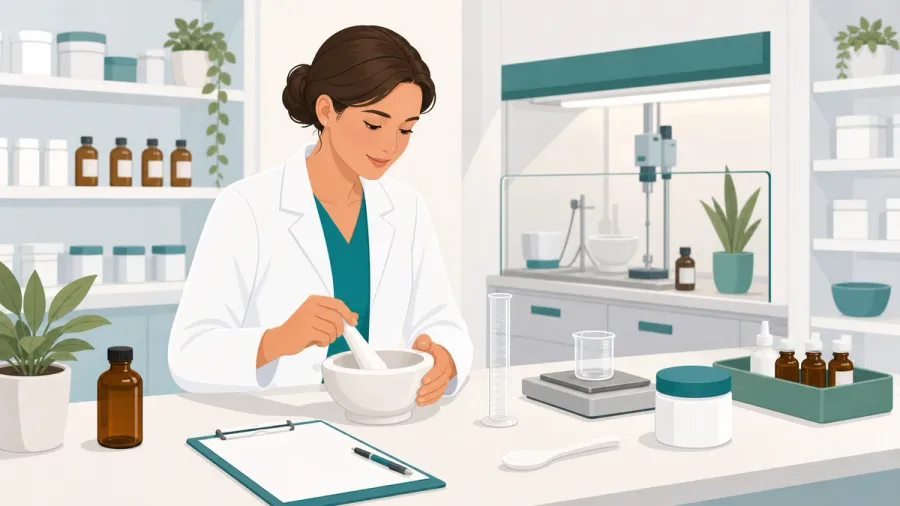
Most of the medicine we take rolls off a production line in identical, mass-manufactured packs. Compounding pharmacies do the opposite: they prepare a medicine for one specific patient, by hand, when a suitable commercial product is not available or not appropriate. It is one of the oldest parts of pharmacy and still one of the most useful. Compounding can solve problems that off-the-shelf products cannot, such as an unusual strength your doctor wants, an allergy to a dye or preservative, a paediatric dose based on a child’s weight, a medicine for a pet, and some shortage situations where the standard product has simply vanished.
It helps to set expectations early. Compounded medicines are not the same as mass-manufactured products. They often carry shorter expiry dates, specific storage requirements, and higher private costs, because someone is making your medicine individually rather than producing a million units at once. A good pharmacist will explain those limits before they prepare anything.
What compounding can actually do
A few real-world examples make the idea concrete:
- A dye or preservative allergy. A patient reacts to a colouring agent in the only commercial tablet of a medicine they need. A compounder can sometimes prepare the active ingredient without that excipient.
- An odd strength. A doctor wants a dose that falls between the commercial strengths, or a very low starting dose to ease a sensitive patient onto a medicine. A compounder can make capsules at that exact strength.
- A swallowing problem. An elderly patient or a child cannot manage tablets, so a suitable medicine is turned into a flavoured liquid.
- A pet. A cat that will not take a bitter tablet may accept a flavoured liquid or a transdermal gel prepared by a compounding pharmacy on a vet’s prescription.
If your need is specifically a liquid medicine for a child, our companion guide to custom liquid medicine for children goes into more detail.
Simple and complex compounding
Not all compounding is equal, and not every compounding pharmacy offers every type.
Simple compounding covers lower-risk preparations such as creams, ointments, oral liquids, and capsules made from established formulas. This is the bread and butter of most compounding pharmacies.
Complex compounding may involve sterile preparations, hazardous medicines, modified-release forms, or formulas that need extra equipment and specialised training. Fewer pharmacies offer this, so it is worth asking which type a pharmacy performs and whether it can make the exact item on your prescription before you send it over.
Questions to ask before you commit
- Does the prescription wording give the pharmacy enough information to make it?
- Is there a commercial product that should be used instead? (A reputable compounder will tell you if there is.)
- What is the beyond-use date, and how should the medicine be stored?
- What will it cost, and can any of it be claimed through a program or private cover?
For children and pets, also ask how the dose is measured and whether the flavouring changes the storage or expiry. A nice flavour is no good if it shortens the shelf life below the length of the course.
Practical Example: A patient is prescribed a medicine that only comes in a tablet containing a dye she is allergic to, and her last experience left her with an uncomfortable reaction. Her GP suggests a compounded version. She searches for pharmacies for one offering compounding services, phones ahead, and the pharmacist confirms they can prepare the active ingredient as a dye-free capsule, explains it will take two days to make and carries a three-month expiry, and gives her the price up front. She gets her medicine without the reaction, and without the trial-and-error of switching brands.
Finding a compounding pharmacy
Use search for pharmacies and filter for compounding. Phone before sending a prescription, especially if the medicine is urgent or needs refrigeration, because some ingredients have to be ordered in.
You can also browse pharmacies in NSW, pharmacies in Victoria, or your own state page to compare locations and opening hours.
Official sources to check
Use professional and safety guidance from:
A good compounder is honest about the boundaries. They will tell you when compounding is the right answer, and just as importantly, when a commercial product, a prescriber review, or a different pharmacy is the safer choice.